

Best Website for Private Practice (2026 Guide)

Updated: May 7
If you’re running a private practice, your website is no longer optional — it’s your main patient acquisition channel.
The problem?Most clinic websites don’t convert.
They look outdated, lack trust, and make it difficult for patients to take action.
👉 In this guide, you’ll learn what actually makes the best website for a private practice — and how to build one that consistently brings in new patient inquiries.
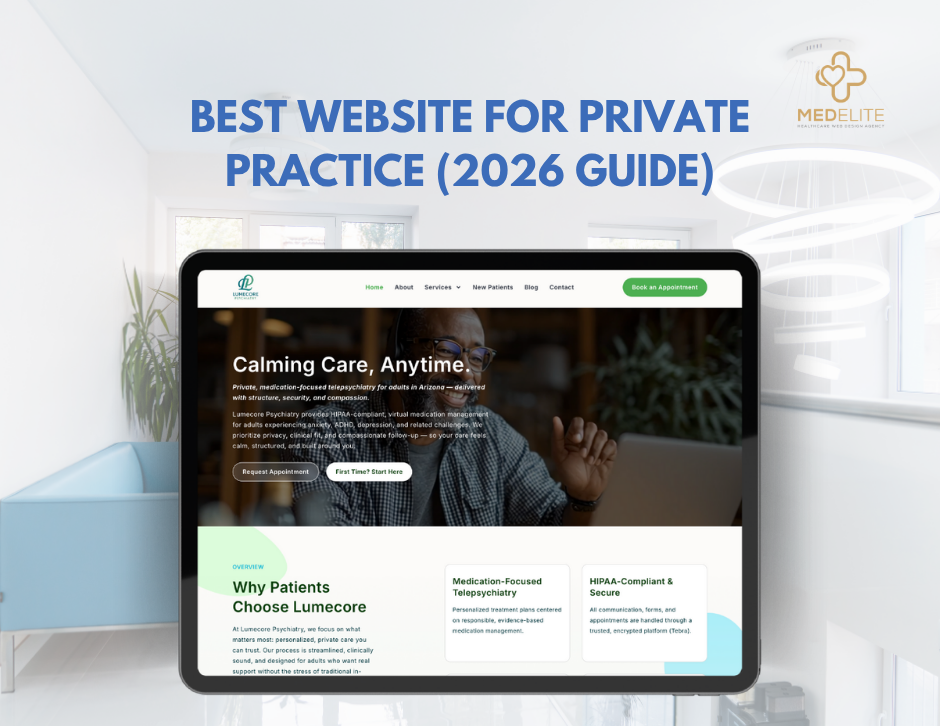
What is the best website for a private practice?
The best website for a private practice is one that:
Builds trust within seconds
Clearly explains services and who they are for
Is HIPAA-compliant (if required)
Is optimized for SEO to attract new patients
Makes booking an appointment simple and fast
A high-performing private practice website combines professional design, clear structure, and conversion-focused elements to turn visitors into patients.
What Makes a Private Practice Website Effective?
A high-performing website does three things:
Builds instant trust
Clearly explains your services
Converts visitors into booked patients
If your website is missing any of these, you’re losing potential patients.
1. Trust Comes First (Healthcare is Different)
Patients don’t just browse — they evaluate.
They are asking:
“Can I trust this provider?”
“Is this professional?”
“Will they understand my problem?”
To build trust instantly, your website should include:
Clean, modern design (not generic templates)
High-quality imagery (or real clinic photos)
Credentials and certifications
Testimonials or reviews
Clear contact details
👉 First impressions happen in under 3 seconds.
2. Clear Website Structure (Most Clinics Get This Wrong)
Confusion kills conversions.
The best private practice websites follow a simple structure:
Essential pages:
Home
About (Doctor / Team)
Services (separate pages — critical for SEO)
Contact / Book Appointment
Blog
High-converting homepage structure:
Clear headline (who you help + outcome)
Services overview
Trust indicators
“How it works” section
Strong call-to-action (Book Appointment)
3. HIPAA Compliance (If You’re in the U.S.)
This is non-negotiable.
Your website must:
Use secure (HIPAA-compliant) forms
Avoid storing patient data improperly
Use secure integrations
👉 Many platforms can be compliant — but it depends on how the site is built.
4. Best Platforms for Private Practice Websites
Wix
Fast to launch
Strong design flexibility
Can be HIPAA-compliant when set up correctly
👉 Best for small to mid-size clinics
WordPress
Highly flexible
Requires more maintenance
👉 Best for scaling practices
Squarespace
Easy to use
Limited for healthcare
👉 Not ideal long-term
5. SEO (How Patients Actually Find You)
If you want consistent patient flow, SEO is essential.
Examples of high-intent searches:
“Anxiety treatment near me”
“ADHD psychiatrist [city]”
“Physiotherapy for back pain [location]”
Your website needs:
Dedicated service pages
Location-based pages
Blog content
Proper SEO setup
👉 Without SEO, you rely only on referrals.
6. Conversion (Turning Visitors into Patients)
Traffic alone isn’t enough.
Your website must convert.
Key elements:
Clear “Book Appointment” buttons
Online scheduling
Simple forms
Mobile optimization
❌ Common Mistakes to Avoid
One-page websites
Generic templates
No clear CTA
Poor navigation
No trust signals
What the Best Private Practice Websites Do Differently
They:
Feel premium and trustworthy
Are simple and easy to navigate
Guide users step-by-step
Focus on patient experience
Final Thoughts
The best website for a private practice is not the most complex.
It’s the one that:
Builds trust instantly
Clearly explains services
Makes booking easy
👉 When done right, your website becomes your most reliable source of new patients.
Need Help With Your Website?
At MedElite Agency, we design high-converting, HIPAA-aware websites for healthcare professionals — built to attract and convert real patients.
FAQs
What is the best platform for a private practice website?
Wix and WordPress are the most popular options. Wix is easier and faster, while WordPress offers more flexibility for larger practices.
Does a private practice website need to be HIPAA compliant?
Yes, if you collect or handle patient information online in the U.S., your website must follow HIPAA guidelines.
How much does a private practice website cost?
Costs vary, but a professional, high-converting website typically ranges from $2,000 to $10,000 depending on complexity.


Comments